Voices from Finland: testimonial from our dealer Minikone

Robustness, comfort and technology at the service of the Far North

The Finnish market has also been a landing place for our Eurocomach machines for several years. We interviewed Aleksi Lampinen, co-owner of Minikone, an excellent partner that now manages a fleet of around 70 machines from our brand.

Hi Aleksi, thank you for being here with us. To start, could you tell us about the history of Minikone and how your partnership with Eurocomach began?

Thank you. I have been with Minikone since 2021, but our history with Eurocomach started around 2015 or 2016. We began with a small rental fleet, and our growth has been constant ever since. Today, we have about 60-70 Eurocomach machines in our fleet and have become a point of reference in Finland, also recognizable by our signature white-colored machines. In addition to rentals, we handle new and used sales, spare parts, and technical assistance.
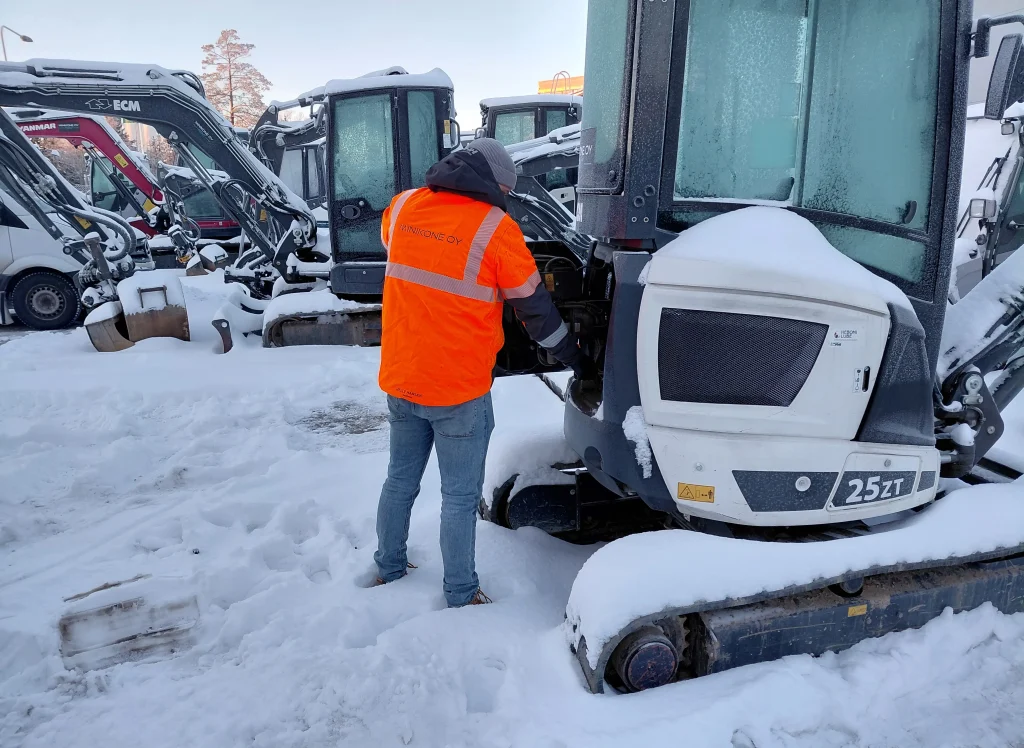
The Finnish market is famous for its extreme weather conditions. Why did you choose our machines to face these challenges?

Mainly for their reliability and robust technology. They are strong machines with powerful engines, yet they maintain a compact size. During the winter, our customers greatly appreciate the comfort: the cabs are well-heated and protected. Since most of our work takes place in the Helsinki area, we need machines that are easy to maneuver in the tight spaces of the capital but powerful enough to handle frozen ground.

Speaking of the operator experience, what impresses your customers the most when they step inside a Eurocomach cab?

Visibility is undoubtedly one of the key strengths. Many of the machines we provide are Zero Tail Swing or short-radius models: this allows operators to have an excellent view of everything happening around the cab, significantly increasing safety on site. Furthermore, they really appreciate the hydraulic precision and general performance; you can feel that these machines are designed for high performance.

From demolition to forestry: tailor-made solutions for the finnish market challenges

Are there any specific sectors or projects where your customers use our excavators?

A very strong sector for us is indoor demolition. Many companies choose our smaller models because they can easily enter buildings to start dismantling from the inside. However, we also see interesting uses in the forestry sector with specific attachments, and even in tunnels. Occasionally, we receive requests for configurations that are rarer in Finland, such as the triple-arm (three-piece boom), which we provide to customers looking for maximum versatility for high-precision work.
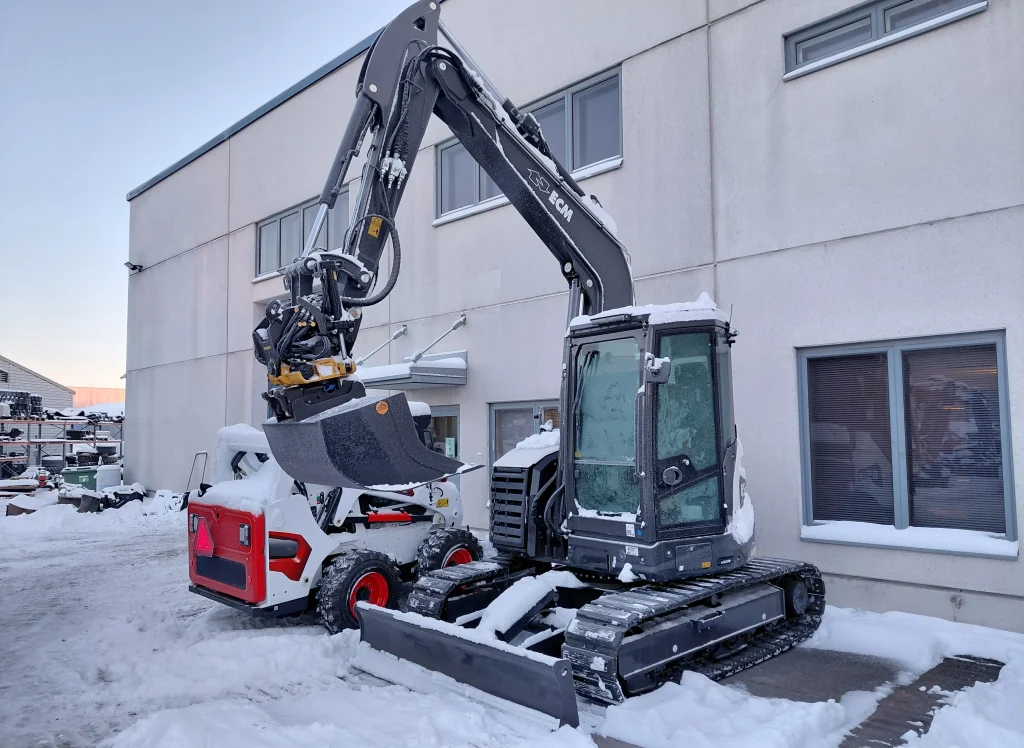
We’ve noticed that in Scandinavia, machine equipment is very specific. What are the most requested attachments?

There is a huge difference here compared to other European markets: in Finland, about 90% of machines over 1.8 tons are equipped with a Tilt Rotator. The ability to rotate and tilt the bucket in every direction has become an indispensable standard for us. Additionally, we often mount timber grabs or cutting heads for forest maintenance.

To conclude, what makes you most proud to represent Eurocomach in your country?

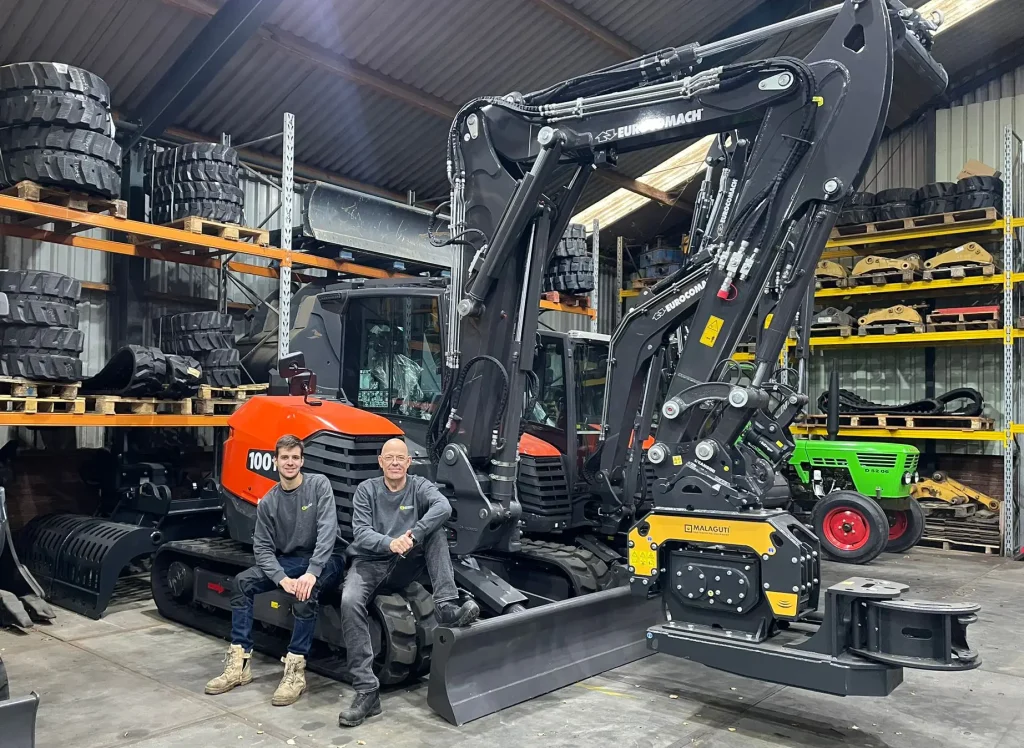
Why Eurocomach? An Interview with Guaita & Schoorl B.V.

From Humble Beginnings to the Start of the Partnership

When did your business start and how did the partnership with Eurocomach begin?

The history of Guaita Schoorl goes further back than our current partnership. My partner, Mr. Guaita, sadly passed away last year. He was born in Italy and moved to Holland. I met him when I was 17 years old, as my father, who was a farmer, had bought a bulldozer from him. We started out buying and selling used equipment all over the world.

In 2002 we started our current business. The biggest part of our business remained used equipment, but we slowly began selling new equipment, primarily attachments from suppliers like Cangini Benne and Trevi Benne.

Dealer Eurocomach Guaita

Then, around 2016 or 2017, we met Marco Mosconi, sales manager. He came here and suggested: “It would be interesting for you to sell Eurocomach.” We started selling them, and from that moment on, it became an important part of our business

We started selling your brand, and from that moment on, it became an important part of our business.

Is there a specific memory from those early days or the first contact that convinced you of that choice?

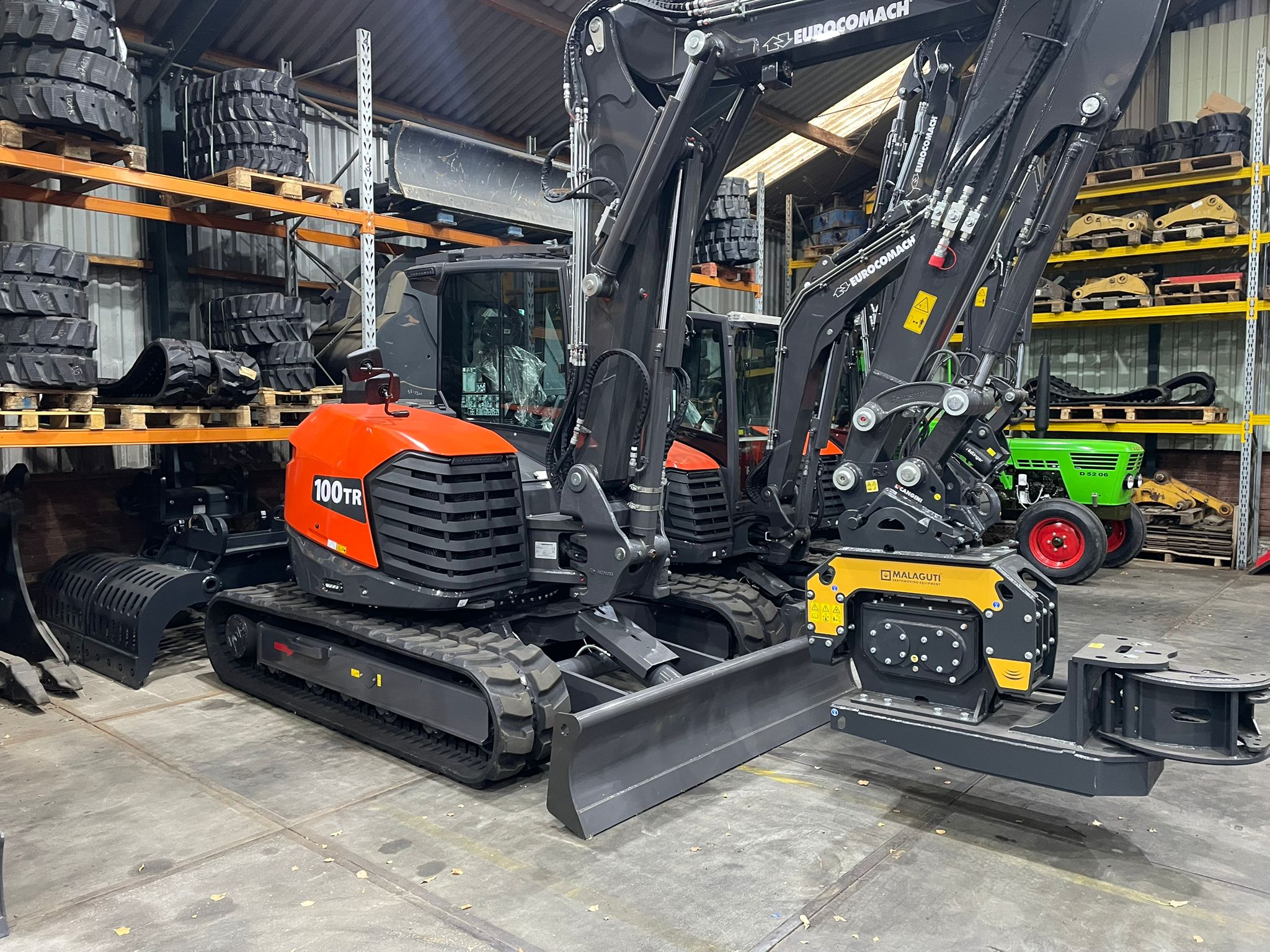
I was more the mechanic; Mr. Guaita was the businessman. When we started with Eurocomach, right from the beginning, it went well. The machines basically sold themselves because we had the 60TR , and you had specialized machines that other brands simply did not offer. You have a niche in the market. We have never sold a mono boom for the 60 model; it’s only the triple boom. That’s what made us big in our part of the country.

Kees also underlines the necessary change in mindset

In the beginning, I was a bit hesitant to start selling new machines because selling in Holland implies a different way of thinking. When you sell machines for export, those machines will go all over the world, and the management of warranty and service follows different logic. If you sell those same machines in Holland to local customers, then you must offer a different space to the clients and a different service, for instance, when they call for technical problems if the machine is broken. So, we had to learn that aspect a little bit.

The Cornerstone of Long-Term Cooperation

What is the one key element that has kept you loyal to the brand throughout this time until now?

The key element? That is success for us: we can make money. If there’s no profit, it’s useless to go on. But we sold a lot of machines in our region, and then the success comes from good reviews from customers.

Customers usually talk among themselves and have reported to us that they are happy with the machine. This has been, and certainly is, good advertising. People are not afraid to buy the machine because other clients have shown satisfaction with the brand. This was the real key element.

The Technical Advantage in the Netherlands

What role does pride in your local territory play in how you present an Eurocomach machine to your clients?

Sometimes we have to modify the machines to make them work for our customers. For example, we put in bigger steel undercarriage if the customer needs them. We do a lot of things to make the machines ready for the customer. If they want something different, we try to do that for the customer.

When you recommend to a client, which technical feature do you know is crucial for a specific job in this region?

The triple boom is very good for us. We have focused on the 19, 45, 55, and 65 models at the moment. Eurocomach machines are powerful; they lift more weight than the competitor. That is always a big advantage. Furthermore, the machines are more modern because all the movements are in the joysticks and nothing is on the floor. Other brands still have pedals on the floor; that is a bit old-fashioned for us. It is very important that the machine is constantly evolving to have the best engineered technology available.

Eurocomach Support: The Critical Difference

Can you share a specific moment when Eurocomach’s support made the critical difference?

If we have a problem we cannot fix—maybe it’s too difficult for us, or it’s unknown, especially when it comes to electronics—it’s very easy to hook the laptop onto the machine and get assistance from Tosca and Francesca.

They can take control of our laptop and access the machine; they can load the new software, make changes, and repair it so that it starts working again. This is excellent support and a superb form of assistance.

This morning, I had a question from a customer about an alarm on a triple boom machine. I asked Tosca for support, and she gave me an answer right away. We, as dealers, and the customers are provided with all the tools to understand what to do and where to look. Our skilled mechanic, Alex, who has been to Italy to learn about the new machines, is doing a good job with electronics because, obviously, this is one of the most important parts right now.

Hira: the first woman researcher in Sampierana

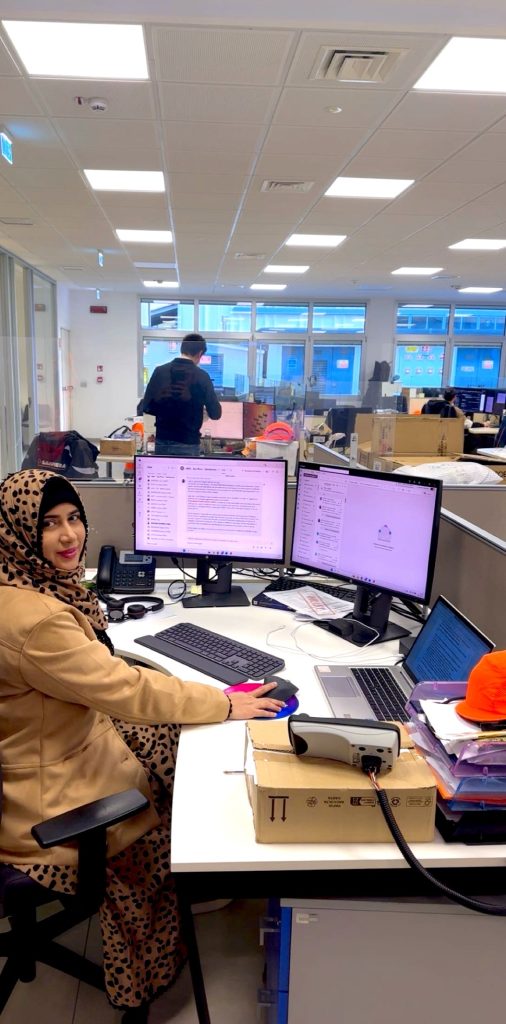
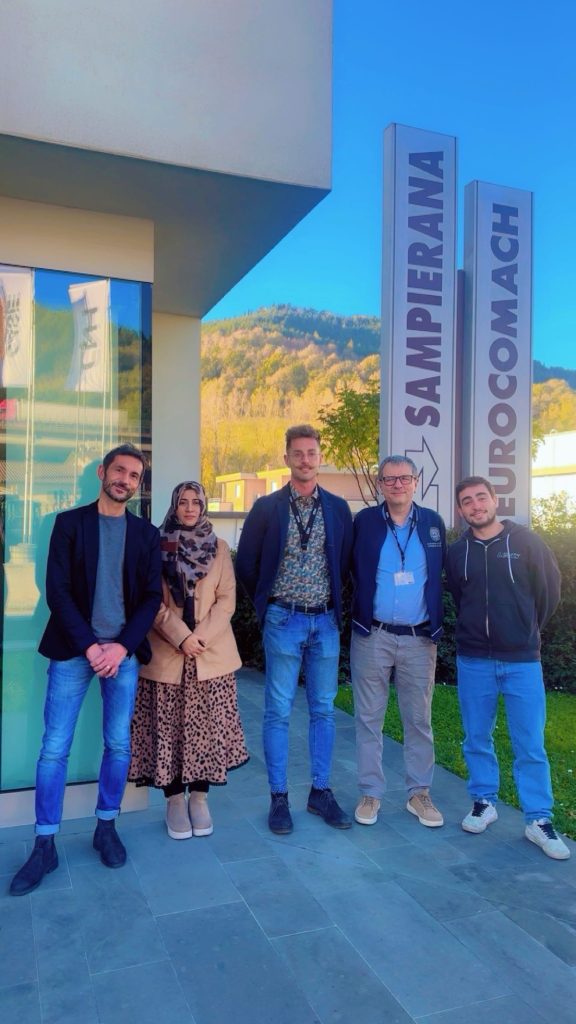
We met Hira, whose presence at our Sampierana plant enriches our research department. With her dark eyes and a calm, yet determined voice, Hira embodies a fascinating and distinct cultural vision, bringing a breath of innovation to our daily work.

Hira is a Researcher directly selected by the University of Bologna (Unibo) for an important project. Backed by a Ph.D. in Communication and Informatics, she is applying her specialized skills—originally focused on intelligent vehicles—to the world of excavators, with a particular focus on electric models.

We interviewed her to hear firsthand about the project she is carrying out here with us, and to discover how her cutting-edge research is shaping the future of our machinery.

How did you start this adventure?

I am a researcher, and I have a Ph. D degree in Communication and Informatics, so it started by applying to Unibo. I saw a project on the Unibo website, basically, it was related to my field. My Ph. D is about Intelligent Vehicles and the vehicles that communicate with infrastructure in other vehicles, like I have seen in Tesla.

The research project is directly connected to my field of study concerning communicating vehicles (V2V/V2D) and their drivers. This technology is vital for excavators in the earthmoving sector, where remote communication is necessary to support operators and improve work efficiency.

I found a specific project focusing on energy optimization and analysis within the earthmoving sector. After applying to the website, I underwent two interviews: a technical interview with the professor and a second with 4-5 people covering more general information. Following this, I was requested to relocate and work in Italy within the construction machinery industry (such as San Piero and CNH), as the project requires a physical presence on-site and cannot be managed entirely remotely.

While you are staying here, are you working in San Piero and also attending university?

I started working in November, and my current time is split between the University and the company plants. Given that my field is Informatics and Computer Science, most of my research analysis can be done remotely.

While you are staying here, are you working in San Piero and also attending university?

When I’m at university, my focus is on planning research notes. However, I am currently in a training phase and not yet performing practical work on the excavators, such as mini excavators, studying the structure of the excavators, analyzing safety components, and reviewing extensive documentation, particularly for electric models.

The goal of this training phase is to thoroughly understand the structure and key parameters. We will only transition to hands-on work with excavators after completing this foundational analysis is complete.

How long have you been planning to stay here?

I am excited to finally apply everything I studied in research and theory to this construction machinery environment.

I plan to stay here for a long time, as I made a deliberate switch from a 10-year career as a University Lecturer (2015-2025) to join the industry. This is the first step in switching my professional field to apply my knowledge in a practical, real-world context.

What is your personal goal in Sampierana?

My personal goal at Sampierana is to apply my PhD expertise in Communication and Vehicles to the earthmoving sector. Drawing inspiration from the CNH view, it is possible to study a system where excavators communicate with each other and with the environment, also taking inspiration from the automotive industry (Tesla is a clear example).

This complete communication procedure must be shifted to the construction machinery industry because it is necessary. Driving excavators is a high-risk task, making drivers and surrounding personnel vulnerable. Therefore, a network for communication and real-time monitoring is essential.

Currently, we lack real-time monitoring of actual vehicle features (like arm movements, joysticks, and brakes), even if we know the GPS location. If we must move a boom, we need remote confirmation that the movement is correct. The goal is to see the complete picture of the work area (e.g., via satellite view) to make better operational decisions, as the driver only sees their specific part. This capability would also allow us to monitor the operator from a distance.

The safety of interconnections is an increasingly prominent topic in the context of earthmoving vehicles.

Hira’s interview allowed us to reflect on new ideas and the evolving role of technology in the earthmoving sector. We are always proud to welcome young faces and voices to Sampierana, as commented by Natalia Bitencourt, HR Product Development & Quality EU:

This collaboration with the University of Cesena represents a fundamental investment in talent and innovation. For Sampierana, focusing on young people and excellent engineering skills is the key to building the future.”


Interview with Fabio: from a family environment to the reality of Sampierana

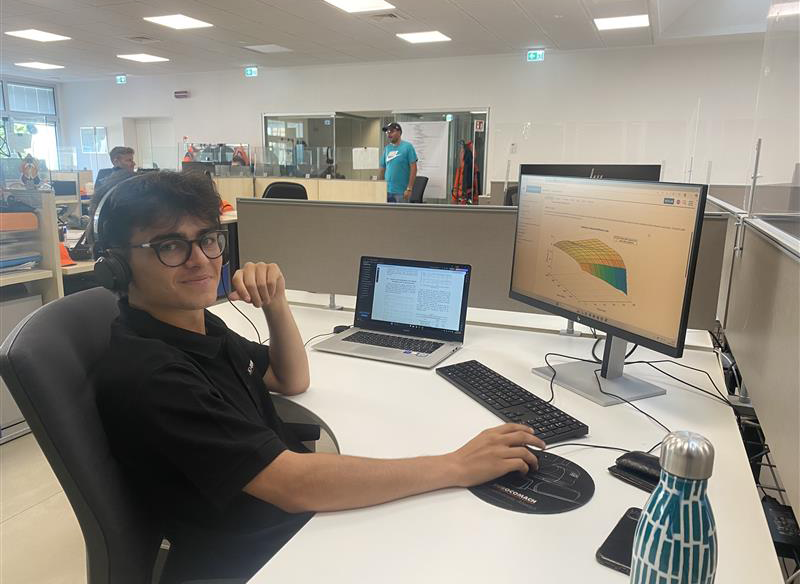
Today, for our Students on Board series, we are sharing an interview with Fabio Sandonini, an electronic engineering intern currently working in the Eurocomach product department. Fabio’s story seems to follow a common thread, originating in the Mantua area, where he comes from, and where he began hearing about and seeing his very first earth-moving machines from a young age.

You started your internship in April, if I’m not mistaken, and you are in the product department. Regarding your studies, you are an electronic engineering student. How was your first month at Sampierana?

The first month went well. For me, it was also my first work experience in my field of study, which is electronic engineering, and in this setting, I had the chance to understand how a technical office works and how to manage relationships with colleagues. I found a very welcoming environment, both with department heads and with other people in the team, and I was finally able to get hands-on with the subjects I had actually studied. So, I would say it was a bit like living what I had always wanted to try and experience

So, regarding your studies, what did you learn at university that you were actually able to apply here at the company?

Definitely the method used to approach a problem, because at university we studied many subjects and a lot of information that don’t always directly relate to what I’m doing in my internship. However, all the concepts share an important factor: the search for the right “method,” understood as problem-solving, identifying the data, reading it accurately, and following it up with adequate analysis. In this respect, I recognize that my studies have supported me. For the rest, a good part of the project I am working on covers what I studied at university, specifically engine technology, electrical systems, and control systems for electric motors.

Intervista Fabio Eurocomach

Which projects did you start working on? / Which projects are you currently working on?

I started working on a project that involves creating a digital model of a vehicle currently being designed in the technical office: an electric vehicle.

My project would be to create this model and simulate it in such a way as to be able to make estimates of the battery’s energy efficiency and power output. So, essentially, taking the vehicle, creating a digital copy, and adjusting the parameters differently to see if higher efficiencies can be achieved.

Did you imagine that you would be able to deepen your studies by applying them to the field of excavators?

Yes and no, I think that’s the correct answer. I got to know Sampierana last year during a meeting with local companies at the Cesena campus. It immediately impressed me as a company because, while I am currently studying in Cesena, I am not from here. I come from a small village between Mantua and Brescia, which is essentially a rural area. My uncles are all farmers, and so are my friends. So the agricultural context is one that I have always lived in and that has always fascinated me, both with earth-moving machinery and agricultural machinery.

When I rediscovered this context at the University, I was immediately struck, and the moment I went to the company—where I actually saw everything up close, including the manufacturing of the machines—I was happy to unite two components: the personal/emotional one and the academic one.

What are you enjoying most about the work you are doing?

Well, there are two aspects to mention: on a practical level, the creation of the model itself, and the fact that once the model is realized, I can play around with certain parameters and see how the machine responds. That’s something I enjoy and that allows me to think about how to improve the machine. On the other hand, the opportunity to work on an electric vehicle, considering the current state of things and the direction the world is heading, makes me proud because it allows me to take part in a large, innovative project that has value for the entire community.

Students on Board: Mattia’s experience at Eurocomach.

The second testimonial of our “Students on Board” series is from Mattia, a Software Engineer at Sampierana. Interviewing him gave us a boost of energy and positivity, which accompanies him daily since he was directly hired after his internship.

Hello Mattia, tell us a little about yourself. Can you tell us about your journey?

It has been a year since I arrived here in October. I was hired as a Software Engineer after completing my studies in Electronic and Telecommunications Engineering.

What were your initial professional goals, and what was the transition from internship to being hired?

Before getting to know Sampierana-Eurocomach, I was interested in the automotive and agricultural machinery sectors. The opportunity came through a seminar organized by the company at the university. An internship is a time to get to know the company, and the workload isn’t as excessive as in a normal job, allowing you to ask more questions. After being hired, the main goal was to bring software, electrical, and electronic know-how in-house at Sampierana, making it more autonomous from suppliers.

Mattia_Students on Board_Eurocomach

What exactly do you do as a Software Engineer?

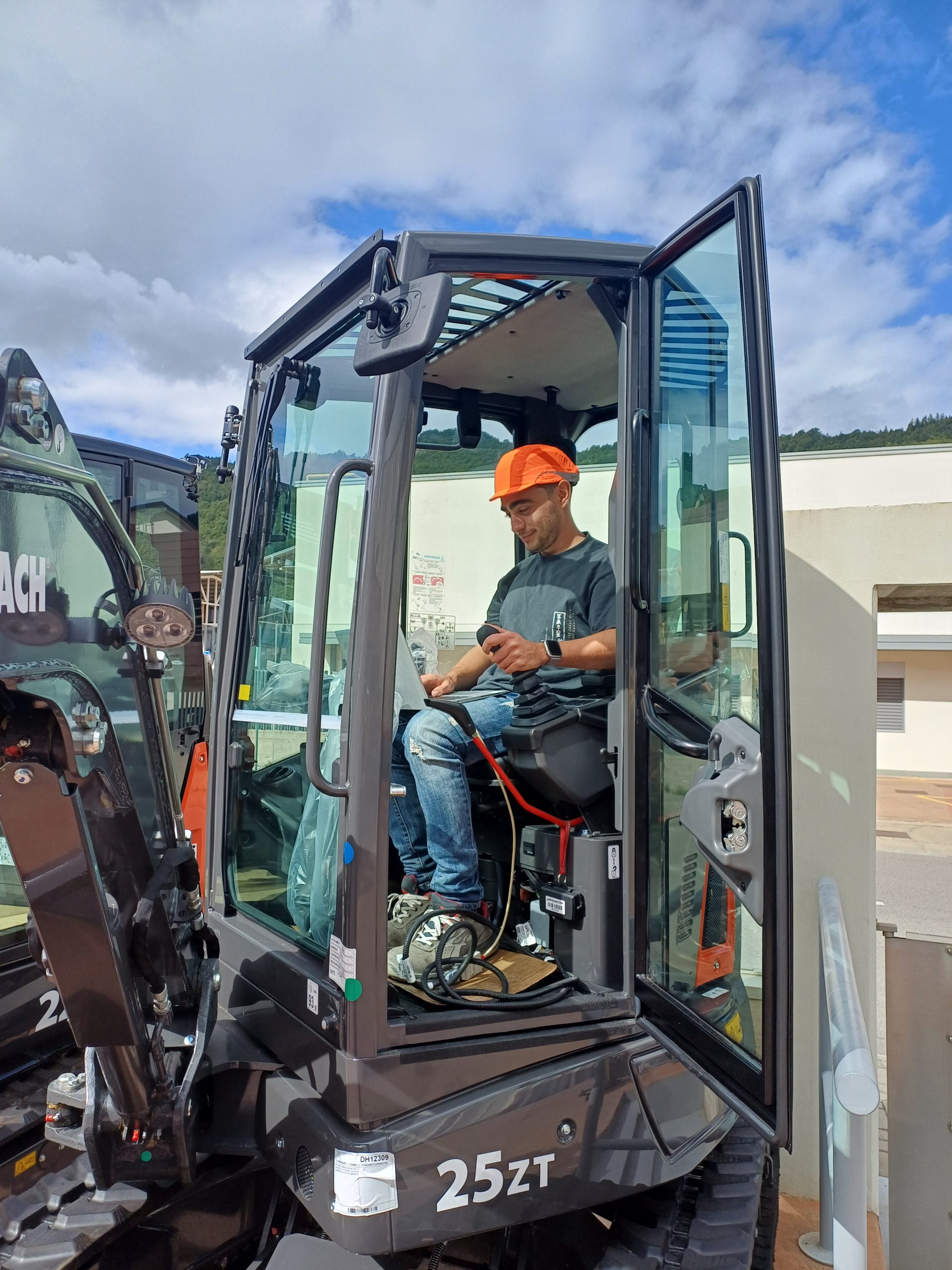
The software, electrical, and electronic parts were not previously managed internally, but through suppliers. The idea is to manage it as the CNH group does, which has its own systems and processes. At the moment, we are following the service and support part for the validation of existing products, but in the future, the goal is to start developing software for new projects. This concerns all excavators, not just the electric ones.

What have you unexpectedly learned during your career?

I learned about the architecture of the machines and how the processes for procurement and component selection are managed. This was the most interesting aspect for me. I also had the opportunity to see how a product is validated, through procedures and tests. At the university level, I never expected to end up in the field of excavators, but if they had asked me two years ago, I probably would have said that I would have liked it. I discovered that my studies gave me the foundation to understand the fields in which electronics are developed.

What was the company’s support like during your internship?

During the internship, I realized that there wasn’t a specific point of reference in my field. However, I had the support of a guy from the technical office and the project manager. When my current manager, Nicolò Rossi, arrived, the approach changed, and even if resources are sometimes lacking, we work to recover them.

Mattia_Students on Board_Eurocomach_escavatore

What is the most interesting or beautiful thing you have learned so far that you perhaps didn’t expect?

The most interesting thing is probably how a product is validated. All the procedures that are done and implemented to check whether a product that has already been designed and built, but not yet put into production by the company, is of sufficient quality or follows the construction specifications through the various tests that are carried out on the products—this aspect is very interesting to me.

Women’s Added Value: Patrizia’s Story

There are many female faces at Sampierana, and this in itself is a source of pride for us. However, one stands out from all the others, perhaps because of her commercial role or perhaps because, when Patrizia talks about excavators, she manages to explain them with disarming simplicity and enthusiasm. It took us two years to convince her, but in the end, we managed to interview her and find out when it all began.

How did your work adventure at Sampierana begin?

It was more or less this time of year, April-May, and the year was 1995. I had finished high school and was working at a company in Cesena, but I wasn’t feeling satisfied. At that moment, I found out they were looking for a reception figure here at Sampierana.

I knew the company because I grew up in these parts. When I introduced myself, they asked me if I knew a bit of languages, mainly English and French. Sampierana at the time was a company of 30 people, and I, fresh out of high school, said yes instantly.

After a few months, however, I was given the opportunity to do something else, which was to get in touch with customers.

And so your commercial adventure began at Sampierana.

Initially, I was responsible for managing orders for the Italian market, with some hesitant approaches to the export market, mainly related to trade fair contacts in neighboring countries (France, Spain), always in the commercial sphere.

Initially, I didn’t think I would stay; I thought I would go to university, that it was a temporary experience, but instead, contact with customers excited me right away, and here I still am.

When did you start traveling in your role as Eurocomach international sales representative?

The turning point came after many years of back-office work, mainly with the 2009 crisis. That year, the Italian market entered a crisis, and we tried to expand our scope beyond the Peninsula and looked for work opportunities everywhere. We even went to Australia and New Zealand. It was essential to broaden our scope to continue working and growing as we had done until then

When you started, were you one of the few female figures in the company?

Yes, at the time, there were few of us. For commercial roles, mostly male figures were sought. After all, the earthmoving sector is primarily made up of men. However, this doesn’t mean there isn’t room for women who want to assert themselves. Potential clients, at the beginning, might have been a bit wary.

if you’re a woman, they tend to constantly put you to the test, so you have to earn their trust. Once earned, you then have to maintain that trust over time, and for this, precision and responsiveness – characteristics perhaps more feminine – which clients recognize and appreciate in me, are absolutely indispensable.

In all of this, what do you think is the greatest achievement?

When they ask you for an opinion, it means you’ve become a point of reference.

A customary question: how did you learn about mini-excavators?

We built our knowledge of mini-excavators in the field, myself included. I was fortunate enough to learn things little by little and also to see the production, to interact with customers at trade fairs. Gradually, I built up my product knowledge, which, it must be said, passionate me, and that’s not a minor factor. Back then, I would go down to the test field near the company, turn on the machine, and enjoy operating the various controls.

I believe this is what helped me: the curiosity to understand the ‘why’ behind things and the daily, direct interaction with the customer.

Do you think that today, with more information available, those approaching machines – both sales personnel and technicians – are less inclined to get hands-on with them?

Yes, today there’s truly a different way of seeing things. I stand by my idea: touching things firsthand helps you understand them better. I’d like to see young people go beyond just being in front of a screen, perhaps see them trying to physically test those famous AUX that are always talked about.

Do you remember when Sampierana started producing mini-excavators?

When Eurocomach was founded, it didn’t make excavators; it made articulated backhoe loaders, a product that has become less and less common over time. For excavators and skid steer loaders (or skids), we initially purchased from Japanese or Korean manufacturers.

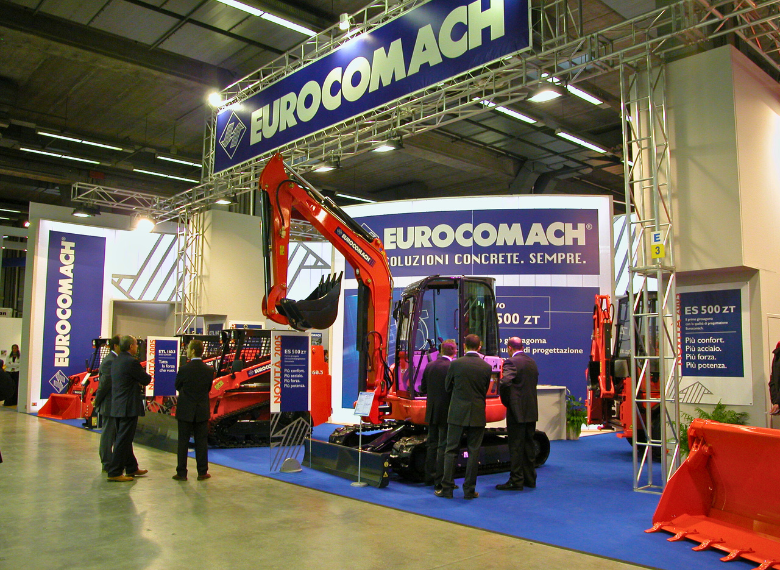
However, these machines did not meet the characteristics of the Italian and European markets. Thinking about what to do, during a meeting, this idea came up: why don’t we make our own? The first Eurocomach mini-excavator model entirely designed and produced in Sampierana was the ES500ZT model; the project manager was Engineer Giuseppe Fabbri, and the machine was presented at an important industry fair, SAIE in Bologna, in October 2004.

SAIE Bologna Eurocomach

And was this the first one you sold?

Yes, it was the first one entirely made by us, and it was a beautiful, well-made, high-performing machine that gave us a lot of satisfaction.

That first unit was meant to help us understand if we were on the right track. The impact was very positive, and from there, we understood that we could launch ourselves, always with the idea of staying within the compact line, and that we should invest more in mini-excavators rather than backhoe loaders (terneh).

Today, among Eurocomach products, which do you think are the strongest?

The market is in a particular moment, but in my opinion, the range of small mini-excavators from 1 to 2 tons has more potential and better meets market needs, and then I continue to have great confidence in the triple booms, in the TRs; if you can make the customer understand the product’s validity, there’s no comparison.

Even for the 8-10 TON mini-excavators with the new electronics, the response has been positive.

How many years have you been working at Sampierana?

I’ve been at Sampierana for 30 years.

If you were to expect something new in your future at Sampierana, what would you expect?

n my opinion, Sampierana as a company has important potential and characteristics to continue producing for many years. Thanks to CNH, the lines have been strengthened, and everything has been organized so well that I see a large production capacity ; it’s clear that the machines, however, need to be sold, and there’s a lot to do here, the competition is fierce.

Patrizia Sampierana Peter Garrit

Before retiring, would you be happy to see another Patrizia at Sampierana?

I would be delighted if some of the girls would launch themselves into the commercial side. I also understand that it’s not simple, because the classic commercial role requires you to be out, to travel, and it can be difficult to combine with family life. Sometimes, however, it’s enough to make a first attempt, almost by chance, as it was for me, and anything can happen!

Metrological Measurement Room and Physical Laboratory: The New Spaces at the San Piero Site

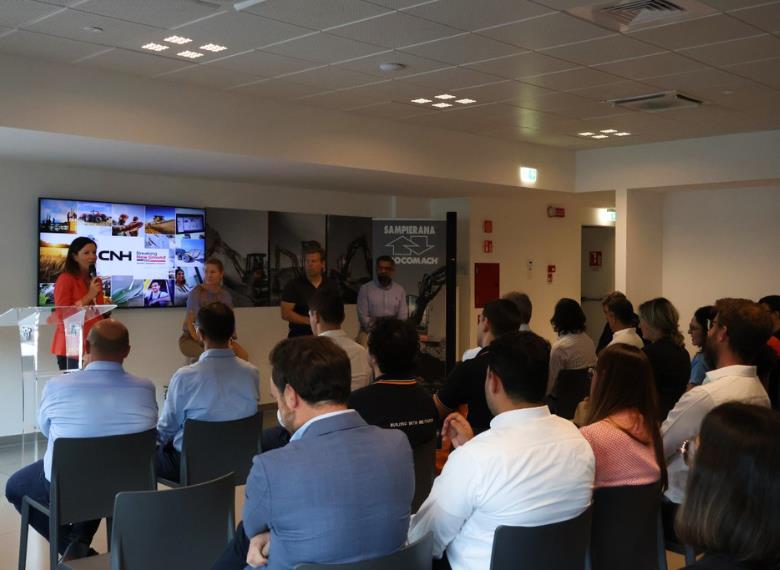
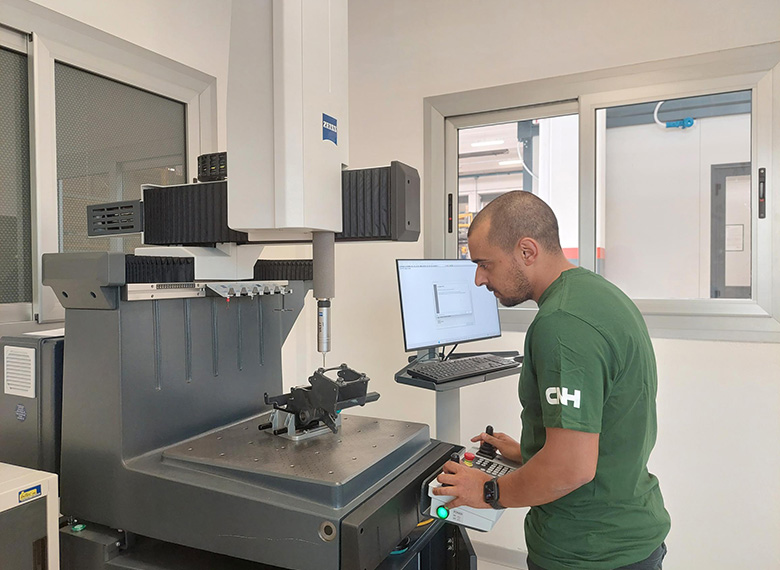
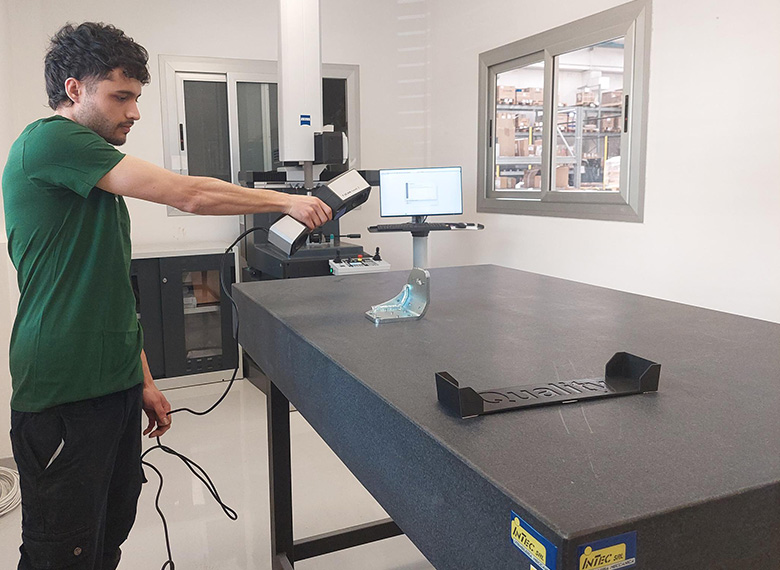
For a few months now, our San Piero in Bagno site has expanded its spaces thanks to the creation of the Metrological Measurement Room and the Physical Laboratory. The goal is to constantly improve daily work and to do so in a “tailor-made” environment.

This space, together with the Laboratory, will support ensuring the utmost precision and reliability of our earthmoving machines.

How and why was the idea for the metrological room born?

Among the reasons that led us to create the metrological measurement room are the pursuit of continuous improvement, technological innovation, and sustainability, in line with the “Breaking New Ground” principles of CNH Industrial.

Among the objectives we set ourselves:

  1. Precision and Reliability:to ensure that all measurements and analyses are carried out with the utmost precision, using equipment and methodologies that comply with international standards. To verify that our measurement systems, including assembly equipment, are reliable and traceable.
  2. Quality and Continuous Improvement: to ensure a constant improvement of measurement and analysis processes, based on feedback, performance review, and innovation.
  3. Metrological or Laboratory Controls: to carry out rigorous checks, where required, upon receipt of goods, for the approval of direct material supplies, as well as to provide support for diagnoses on the materials used by our machines, both preventively and reactively, all in compliance with ISO9001:2025.
  4. Sustainability: to adopt sustainable practices that minimize the environmental impact of laboratory operations and the measurement room.
Sala Metrologica attrezzature

The introduction of the metrological room responds not only to specific objectives but also to a series of quality strategies

  • Resource Management: by referring to a specific space, we ensure that all resources, including measuring equipment and laboratory devices, are available, maintained, and calibrated regularly. On the other hand, we are committed to ensuring that personnel have the necessary skills through continuous training.
  • Control and Monitoring: to implement control and monitoring systems to constantly evaluate and improve the performance of measurements and analyses. To use measuring instruments calibrated or verified according to international standards.
  • Work Environment: to create and maintain a work environment suitable for precise and reliable operations, including temperature, humidity, and cleanliness control.
  • Collaboration and Communication: to foster a collaborative work environment where effective communication and teamwork are encouraged and valued.
Sala Metrologica attrezzature qualità

The commitment of the Sampierana Management is to provide the necessary resources to support continuous improvement and promote a quality-oriented work environment. In the coming months, the opening of the metrological room will be officially announced, an opportunity to inaugurate the result of this teamwork together.

Banner x News

Piernicolò and the world of Spare Parts

We’re a company within the company, I think it’s fair to define us as a sort of first aid, available to the dealers who contact us

The cafeteria building also hides a part of Sampierana-branded offices, perhaps those that are usually glanced at less or that are sometimes easier to forget. Right behind one of those doors, however, there are other faces, other stories, and other hands at work, those of Sampierana-branded Spare Parts.

Today we give space to them and to a particular name, that of Piernicolò, who has been working at Sampierana since 2019.

From Sicily to San Piero. How did your adventure at Sampierana begin?

My adventure at Sampierana began on May 22, 2019. I started as a worker unexpectedly, thanks to a meeting at my school with the founders of Sampierana who were visiting to select new personnel. After the in-person interviews, which were fortunately positive, I was contacted. Initially, I was hesitant because I had chosen the Faculty of Literature at University and was doing very well, but when the call came, I decided to go.

Once I entered the company world, I became passionate about Sampierana, its products, and also the people, day after day. I have been working in the spare parts team since September 26, 2022.

Tell us some more details about the spare parts team. During the purchase process or a simple request from the customer, when does your team come into play?

Over the years, a spare parts portal was developed on the initiative of the insiders because managing order entries by phone or email had become obsolete (once the orders were taken by phone, all phases were organized: purchase, management, packing, shipping) both at a “practical” and documentary/management level.

The development of the spare parts portal took place after a great deal of coordinated work with some colleagues from the technical office and the IT office. To date, the spare parts portal is a tried and tested reality and is constantly being innovated.

The team, composed precisely of both white-collar and blue-collar workers, follows all phases as if it were a micro-company: Purchasing, warehouse management, order/stock management, shipping, and invoicing in almost complete autonomy.

When the customer places an order, it is first supervised and authorized by us, after which our warehouse worker can already see it on the handheld device and manage it following the locations and stock levels up to packaging.

The team manages an average of over 15,000 shipments per year between sales and warranties. This translates into an indispensable service for over 300 Eurocomach dealers worldwide who can normally be served within 24/48 hours of order confirmation.

Also for the entire CNH market, closely linked to our warehouse for the supply of their stocking warehouses in Modena and not infrequently shipments to the USA.

Have you had a drop in requests in recent months?

When there is a drop in machine sales, spare parts become even more indispensable than they already are. We are a sort of first aid in our world.

How many people work in your team?

In total, there are five of us. There is Alessandro, who, in addition to being the department coordinator, manages all orders coming from the web; Nicola, who manages purchases; and myself, who handles everything related to customer support, therefore strictly sales. Letizia, who provides support to Alessandro and follows the complex CNH dynamics.

Then there are our warehouse workers: Matteo, Arianna, Edgar, Antonio, Francesca, and Luca (who shuttles between us and Attachments).

Do you have KPIs as a team, how is your work measured?

It’s all based on the here and now, we move based on daily requests.

Do you also provide consulting to the customer when they request a spare part?

Normally, the customer can place the order independently, but my role also includes this.

How does contact occur between you and the customer who needs a spare part? If, for example, there is a problem on the portal, who provides support?

For any sales-related need, I remain the point of contact for our dealers worldwide. At the moment, there is no direct contact of mine on the portal, but you know that now that I think about it, it’s not a bad idea? To date, they call the switchboard or send an email to infosampierana@cnh.com, and then they pass on my contact or it is forwarded to me immediately.

So, you also collaborate a lot with the After Sales team?

Absolutely! We manage all their shipments; the collaboration is one of absolute synergy. As Henry Ford said, “The first car is sold by the sales department, the others are ‘sold’ by after-sales service.” I don’t want to diminish the work of our sales team, but simply to emphasize ours, just to be clear!

You told us that you had enrolled in the Faculty of Letters, but once you entered the Sampierana world, you were able to train and find your way. What are the skills for those who want to approach the spare parts sector?

Ideally, it would be good to already know the machines, or at least have a general idea, strictly speaking about my job. Regarding our team, however, we have shown that the necessary skills are many and each of us can contribute even without prior experience; the important thing is to be flexible, dynamic, and predisposed to teamwork.

We say goodbye to Piernicolò with the promise to come back more often to knock on the door of the spare parts team, sometimes a few more steps are enough to shorten the “physical” distances from one office to another.

Angelica Sampierana attachments

The voices of Sampierana Attachments: Angelica

When did your journey begin in Sampierana? .

I joined the company in 2021 and for six months I worked in reception, welcoming customers and providing support for various requests.

In December 2021, Mattia, my current manager, asked me if I would be interested in working specifically in the attachments sector. An opportunity that I immediately grabbed with enthusiasm and a desire to get involved.

How was the change? Did you find yourself in difficulty at the beginning?

I had a very soft start. From April 2022, I became a permanent figure on attachments, initially in a backoffice role and then in a commercial role.

When the previous equipment sales manager resigned, my colleague Paola and I took over the reins of this part of the business. I for Italy, she for Spain.

From October 2023 I started visiting customers and getting to know them in person.

Have you been able to train yourself on earthmoving equipment?

I slowly built up new knowledge of equipment. The equipment department was always a mixed backoffice, the English and German market followed Paola.

I also studied at home to be independent. I wasn’t required to have the technical knowledge when the old salesman left, but I was lucky enough and also willing to become passionate about the sector. When you study something that you like and are interested in, it happens.

I had already got to know some customers in reception and a human relationship had been established. My first contact with them was born in that context and it served me well to practise patience and assertiveness towards the customer.

Angelica Sampierana attachments

As with the other colleagues, a question arises spontaneously and necessary: did you find it difficult to be accepted or to gain credibility in a sector that is still purely male?

When I moved on to attachments and became, like other colleagues, an important point of contact, it wasn’t easy, but little by little I won them over. Even this type of change takes time. Now there is a good relationship of trust with my clients and colleagues.

Have your university studies been important in this career path?

I studied languages and translation, a branch of the Faculty of Languages ​​for Corporate Communication. I don’t feel too far from what I studied, especially since CNH arrived.

During my university years I studied in Spain and worked for six months in England, I stayed there for a few months. I worked for an agency for several airlines and was responsible for carrying out pre-employment checks for all flight staff. I translated their contracts, talked to them on the phone. The work in England was a piece to get here.

Spain, England and then Romagna again and not just any place, but the one where you were born. What did coming back here mean for you?

From my town you travel more towards the city than towards the hills. I came back by choice, even when I left I knew that, at some point, I would return here. On a personal level I have built a network of friendships with colleagues, on a work level I feel gratified and I have a job that allows me to travel all over Italy. In England they had asked me to stay, but I was sure I wanted to return.

What is one of the difficult aspects of your job?

The possibility of making mistakes if you are not technically prepared. The world of equipment is very broad and above all we are very dynamic, we often re-evaluate our suppliers and also the types of equipment, therefore, it is important to always be on top of things.

Angelica back office Sampierana

Another adventure will begin soon for you, that of motherhood. In the reality of Sampierana, however, it is quite common to come across women’s bellies in the corridors. How did you experience this change in relation to your work?

When I found out I was pregnant I was afraid to show my belly. Instead, my clients surprised me first: they ask me how the pregnancy is going, how I’m doing and then I was supported by my colleagues and my manager who fought every day to allow me to continue doing the job I love without problems or doubts.

What would you suggest to those who want to enter the sector?

To keep curiosity alive, because in this sector it is the drive that leads you to learn. If you are curious you learn and if you learn you have fun.

Banner x News

MTL50: the new Eurocomach mini track loader

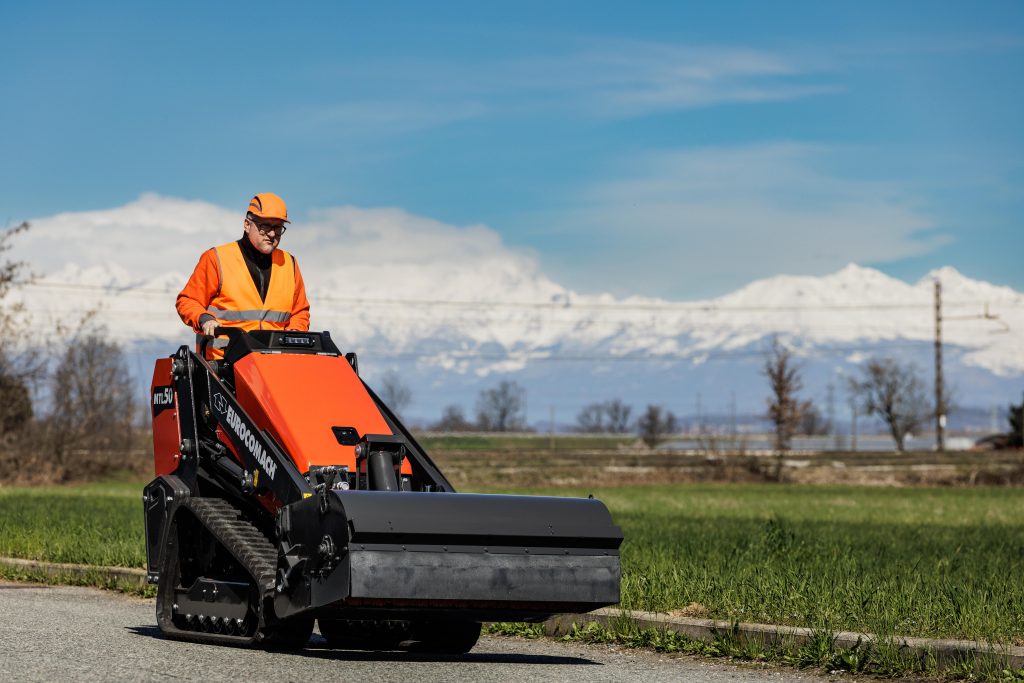
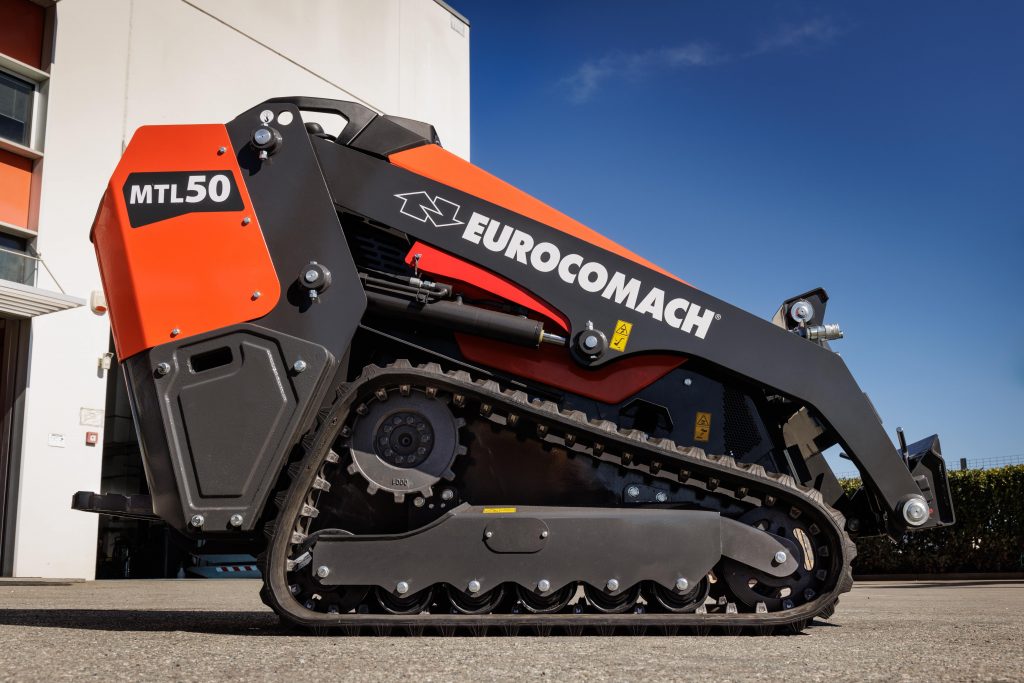
Ready to use, versatile, suitable for outdoor work, but also for the most limited indoor spaces: the new Eurocomach MTL50 is the right solution for large and small projects to be handled quickly and efficiently. The mini track loader, ready to be launched on the Italian and foreign markets in May 2024, is a machine always ready and versatile.

MTL50

Among the strengths of the MTL50 it should be mentioned:

  • Multi-functionality: the MTL’s set-up is completed with a wide range of mountable equipment (hydraulic and electric) thanks to the CII quick coupling interface, standard for this type of product;
  • Adaptable to any space: The MTL is available in both narrow track (track width 180 mm with a bucket width of 914 mm) and wide track (track width 250 mm with a bucket width of 1050 mm) versions. The wide track reduces ground pressure and maximizes stability;
  • Ready to use: we defined it as a ‘ready’ machine. The operator can step directly onto the platform and start work in any condition. From the platform, it is possible to have maximum visibility while maintaining the highest level of safety;
  • Powerful and unstoppable: the MTL guarantees strength in thrust and traction, as well as load capacity. Maximum traction is guaranteed on all types and conditions of terrain.


Eurocomach MTL50

ONE MACHINE MANY EQUIPMENT

Every job requires the right equipment, and with the MTL it is possible to use the full range of CNH-branded equipment, making it suitable for the most diverse contexts from construction to agriculture (renovations, vineyards, areas where mud or debris has to be removed, green maintenance). Equipment compatible with the MTL50 includes:

  • Various types of buckets with hangers (industrial, agricultural, and forestry);
  • Different types of flail heads;
  • Drill;
  • Forks Pallet;
  • Asphalt Milling Machine;
  • Blade Snow;
  • Blade Dozer;
  • Catenary
  • Sweeper;
  • Scraper Blade;
  • Grapple;
  • Hammer

The innovative design of the MTL50 meets the needs of all customers, even the most demanding.

Ready to test it in the field? Contact now our sales representatives for more information.

Download the MTL50 data sheet