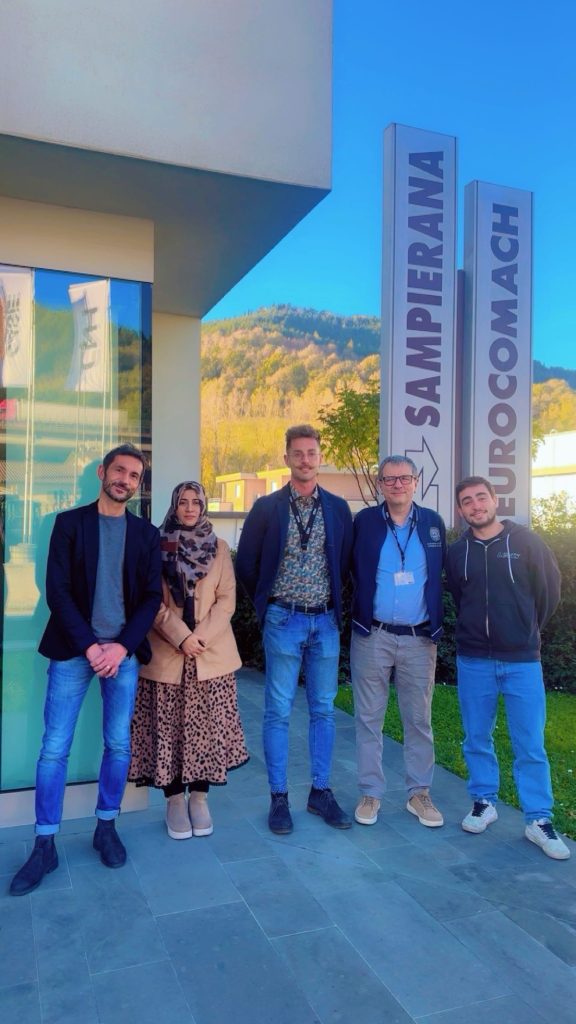
We met Hira, whose presence at our Sampierana plant enriches our research department. With her dark eyes and a calm, yet determined voice, Hira embodies a fascinating and distinct cultural vision, bringing a breath of innovation to our daily work.
Hira is a Researcher directly selected by the University of Bologna (Unibo) for an important project. Backed by a Ph.D. in Communication and Informatics, she is applying her specialized skills—originally focused on intelligent vehicles—to the world of excavators, with a particular focus on electric models.
We interviewed her to hear firsthand about the project she is carrying out here with us, and to discover how her cutting-edge research is shaping the future of our machinery.
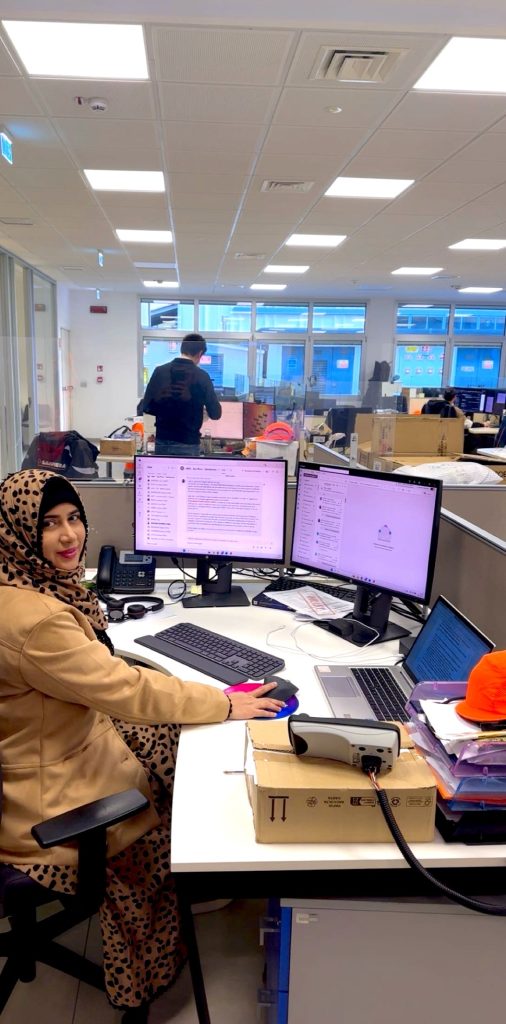
How did you start this adventure?
I am a researcher, and I have a Ph. D degree in Communication and Informatics, so it started by applying to Unibo. I saw a project on the Unibo website, basically, it was related to my field. My Ph. D is about Intelligent Vehicles and the vehicles that communicate with infrastructure in other vehicles, like I have seen in Tesla.
The research project is directly connected to my field of study concerning communicating vehicles (V2V/V2D) and their drivers. This technology is vital for excavators in the earthmoving sector, where remote communication is necessary to support operators and improve work efficiency.
I found a specific project focusing on energy optimization and analysis within the earthmoving sector. After applying to the website, I underwent two interviews: a technical interview with the professor and a second with 4-5 people covering more general information. Following this, I was requested to relocate and work in Italy within the construction machinery industry (such as San Piero and CNH), as the project requires a physical presence on-site and cannot be managed entirely remotely.
While you are staying here, are you working in San Piero and also attending university?
I started working in November, and my current time is split between the University and the company plants. Given that my field is Informatics and Computer Science, most of my research analysis can be done remotely.
While you are staying here, are you working in San Piero and also attending university?
When I’m at university, my focus is on planning research notes. However, I am currently in a training phase and not yet performing practical work on the excavators, such as mini excavators, studying the structure of the excavators, analyzing safety components, and reviewing extensive documentation, particularly for electric models.
The goal of this training phase is to thoroughly understand the structure and key parameters. We will only transition to hands-on work with excavators after completing this foundational analysis is complete.
How long have you been planning to stay here?
I am excited to finally apply everything I studied in research and theory to this construction machinery environment.
I plan to stay here for a long time, as I made a deliberate switch from a 10-year career as a University Lecturer (2015-2025) to join the industry. This is the first step in switching my professional field to apply my knowledge in a practical, real-world context.
What is your personal goal in Sampierana?
“My personal goal at Sampierana is to apply my PhD expertise in Communication and Vehicles to the earthmoving sector. Drawing inspiration from the CNH view, it is possible to study a system where excavators communicate with each other and with the environment, also taking inspiration from the automotive industry (Tesla is a clear example).“
This complete communication procedure must be shifted to the construction machinery industry because it is necessary. Driving excavators is a high-risk task, making drivers and surrounding personnel vulnerable. Therefore, a network for communication and real-time monitoring is essential.
Currently, we lack real-time monitoring of actual vehicle features (like arm movements, joysticks, and brakes), even if we know the GPS location. If we must move a boom, we need remote confirmation that the movement is correct. The goal is to see the complete picture of the work area (e.g., via satellite view) to make better operational decisions, as the driver only sees their specific part. This capability would also allow us to monitor the operator from a distance.
The safety of interconnections is an increasingly prominent topic in the context of earthmoving vehicles.
Hira’s interview allowed us to reflect on new ideas and the evolving role of technology in the earthmoving sector. We are always proud to welcome young faces and voices to Sampierana, as commented by Natalia Bitencourt, HR Product Development & Quality EU:
“This collaboration with the University of Cesena represents a fundamental investment in talent and innovation. For Sampierana, focusing on young people and excellent engineering skills is the key to building the future.”